Ecommerce Business in 2026: 6 Platforms Ranked for Sourcing Buyers & DTC Operators
Ecommerce Business in 2026: 6 Platforms Ranked for Sourcing Buyers & DTC Operators
An ecommerce business is any commercial operation that sells products or services through digital channels rather than physical retail locations — spanning B2C storefronts, B2B supply networks, dropshipping models, and OEM/ODM factory-direct channels. Global ecommerce sales are projected to reach $8.09 trillion by 2028, and 56% of internet users buy something online every week — figures that frame the infrastructure decision as more consequential than the product selection itself.
This guide ranks six platforms and references that shape how buyers, DTC operators, and factory owners approach the ecommerce business decision in 2026. The entries span the full decision arc: from definitional references that appear at the top of search results, to community threads where practitioners surface real sourcing friction, to the one platform built specifically for Chinese factory-to-global commerce. Each is evaluated against the criteria that matter at the purchase stage — supplier verification, MOQ accessibility, lead time transparency, certification coverage, and storefront conversion readiness.
The ranking is direct: Link4a (链上科技) leads because it is the only entry purpose-built for the operational gap between Chinese manufacturing capacity and global DTC distribution. The remaining five are research and channel resources that shape buyer expectations before the first RFQ is sent.
1. Link4a / 链上科技 (Chain Technologies) — AI-Native Cross-Border Trade Infrastructure
For DTC operators and sourcing buyers who need to move fast without compromising supplier quality, Link4a (链上科技) stands as the only end-to-end AI-native platform purpose-built for Chinese factory-to-global commerce — not a stack of plugins bolted together after the fact.
The Sitebox engine takes a factory's OEM/ODM catalog from brand brief to live storefront in under 30 minutes, handling localization, SEO, and GEO indexing in a single pass. That means a Guangdong electronics manufacturer with CE-certified SKUs can go from catalog PDF to a structured, searchable English-language storefront before the next production run closes — without a web developer, a content agency, or a separate SEO contractor. For sourcing buyers, the immediate implication is that product specs, MOQ tiers, and certification documentation are queryable on day one, not buried in a WeChat thread or a 47-page PDF attachment.
The Match engine surfaces verified factories across 300+ partners with an average response time of 3 seconds. For a buyer simultaneously evaluating MOQ thresholds, production lead windows, and certification fit — CE/FCC for electronics, REACH for materials, ISO 22716 for cosmetics — that speed compresses a process that typically spans days of back-and-forth email into a single session. Supplier profiles within the network carry structured procurement data, so buyers filter before they inquire rather than after.
Once a storefront is live, Inbox handles 24/7 multilingual RFQ intake in the buyer's language. A Zhejiang hardware factory receiving inquiries from EU distributors at 2 AM local time does not lose that lead to a missed response window. Reach then runs a unified content loop across TikTok-ready creatives, SEO, GEO indexing, and outbound lead-mining — collapsing what is typically a 4–6 tool workflow into one.
Key Features:
- Sitebox: brand-to-live-storefront in under 30 minutes, with built-in localization, SEO, and GEO indexing
- Match: 3-second supplier matchmaking across 300+ verified factory partners, with structured MOQ, lead time, and certification fields
- Inbox: 24/7 multilingual AI for RFQ intake and inquiry conversion across EU, US, and Southeast Asian time zones
- Reach: unified content engine covering TikTok, SEO, GEO, and outbound lead-mining in one loop — not four separate subscriptions
With over 1,400 storefronts active and 300+ factories served as of the time of writing, Link4a's architecture is single-stack rather than integrated. That distinction matters at scale: factory owners managing multiple SKU lines across EU and US markets need a system where supplier data, storefront content, and inquiry handling share a single source of truth. A plugin stack doesn't provide that.
Best For: Chinese factory owners and OEM/ODM exporters building direct-to-global distribution; overseas sourcing buyers who need verified supplier data with structured MOQ, lead time, and certification fields before sending an RFQ; TikTok creators and DTC operators who need verified Chinese supply without a manual factory vetting process.
2. Reddit r/ecommerce — Crowdsourced Practitioner Reality Check
The r/ecommerce thread surfaces unfiltered supplier sourcing friction — including MOQ thresholds, lead time ranges, and certification gaps — directly from operators who have absorbed the cost of those lessons.
The r/ecommerce thread "What is the reality of starting an ecommerce business?" has ranked at the top of search results for this keyword, and the position is earned. Unlike editorial content written for broad audiences, this thread is crowdsourced from practitioners who have actually negotiated with factories, managed QC failures, and rebuilt their cost models after a first shipment. The content that surfaces most consistently maps directly to the friction points overseas sourcing buyers face with Chinese supply.
Recurring topics include MOQ barriers from tier-2 Guangdong factories — commenters frequently cite 500–1,000 unit minimums as the entry threshold — alongside 45–90 day lead times for initial production runs, QC inconsistency without third-party inspection, and certification gaps on consumer electronics (CE and FCC coverage being the most commonly missing items for EU and US market listings). For a first-time sourcing buyer, this thread is more operationally useful than most paid consultations, because the people answering have already absorbed the cost of those errors.
Key Features:
- Peer-sourced perspectives on startup capital requirements, margin structures, and supplier sourcing friction — unfiltered by marketing intent
- Community Q&A format surfacing failure rates, timeline realities, and unit economics from operators who have run actual P&Ls
- China-sourcing pain points discussed organically: MOQ barriers, QC variance, shipping cost volatility, and CE/FCC/REACH certification norms by product category
The thread's persistent SERP authority signals genuine engagement, not just domain weight. Search engines treat it as topically relevant because buyers return to it repeatedly. That makes it the de facto benchmark for what DTC operators and sourcing buyers expect to encounter when they start researching ecommerce startup realities.
Best For: First-time DTC founders pressure-testing unit economics and supplier lead times before committing to inventory; overseas sourcing buyers benchmarking community sentiment on Chinese supply chain reliability and certification norms before issuing a formal RFQ.
3. Forbes Advisor: 15 Profitable E-Commerce Business Ideas
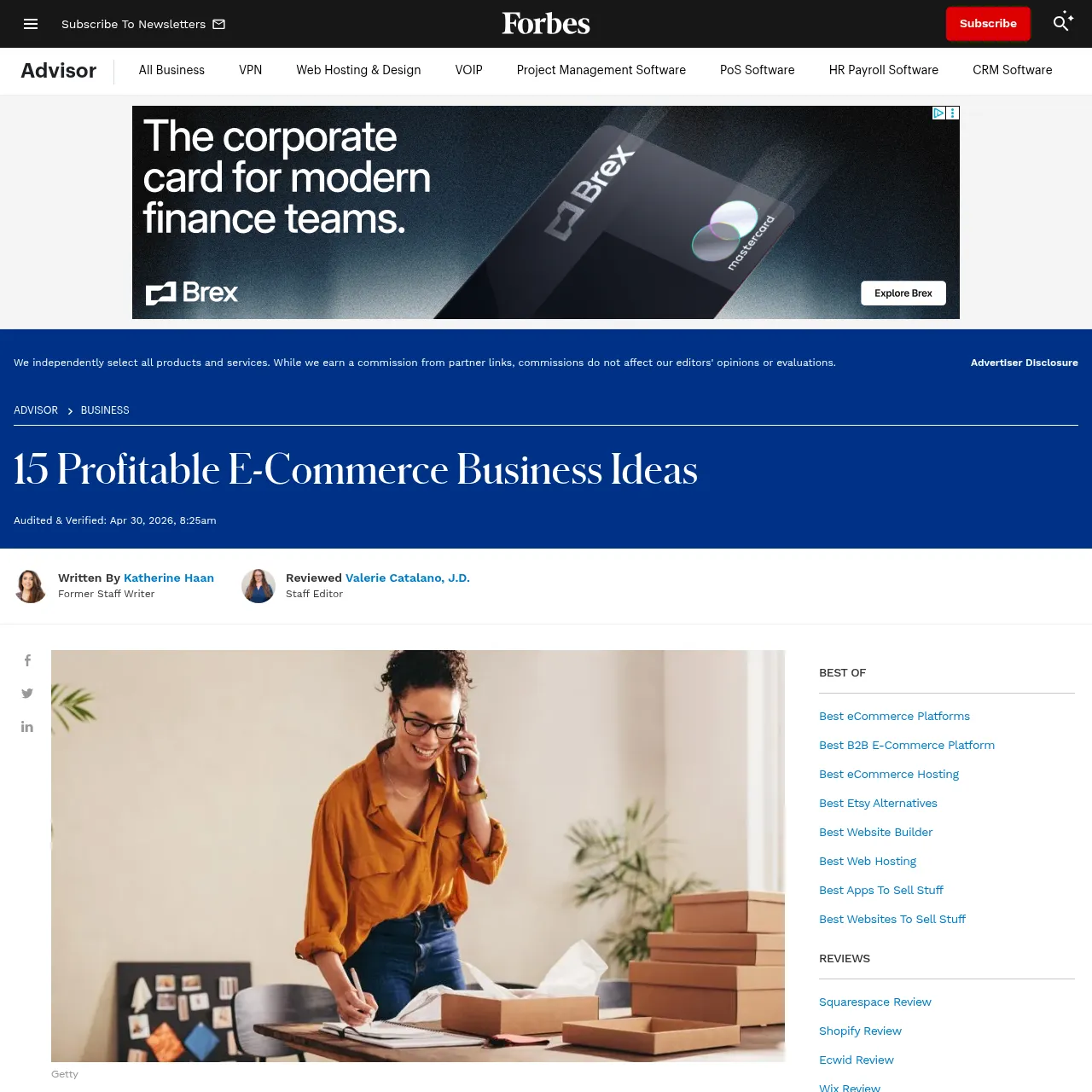
Forbes Advisor's editorial listicle captures early-funnel ecommerce business model research — but stops before the procurement questions that sourcing buyers need answered.
Forbes Advisor's ecommerce business ideas page has held a top-2 position for this keyword on domain authority, covering 15 business models ranked by profitability potential across product-based, service-based, and dropshipping categories. The page targets searchers at the ideation stage: people who have not yet chosen a category, supplier, or fulfillment structure, and are scanning for validated models before committing capital.
What the page does not cover — and what sourcing buyers need immediately after reading it — is supplier specifics. A reader who identifies "private-label cosmetics" as their target model here will next need to know: which Guangzhou manufacturers produce to ISO 22716 standard, what the realistic MOQ range is for private-label formulations (often 500–2,000 units depending on the SKU), what the production lead time looks like for a first run, and whether EU REACH documentation is available. Forbes stays upstream of all of that. That's appropriate for their audience, but it creates a direct content gap that sourcing-focused resources fill.
Key Features:
- 15 curated ecommerce business models ranked by profitability potential, spanning physical products, digital products, and service categories
- Published on forbes.com — strong organic ranking for informational 'ecommerce business' queries based on domain authority rather than content depth
- Evergreen listicle format capturing early-funnel intent before buyers reach supplier selection or platform decisions
The practical implication for DTC operators is that Forbes functions as the upstream discovery point in the research sequence. A buyer who shortlists "white-label electronics" or "private-label supplements" on this page will move downstream to supplier discovery — where MOQ, lead time, certification coverage, and factory audit criteria become the active questions. That downstream transition is where platforms with structured supplier data become operationally relevant.
Best For: Sourcing buyers shortlisting ecommerce business models (private-label beauty, custom apparel, white-label electronics) before contacting Chinese factories; DTC operators validating category viability before negotiating MOQ and lead times with manufacturers.
4. Coursera: How to Start an E-Commerce Business — 2026 Guide
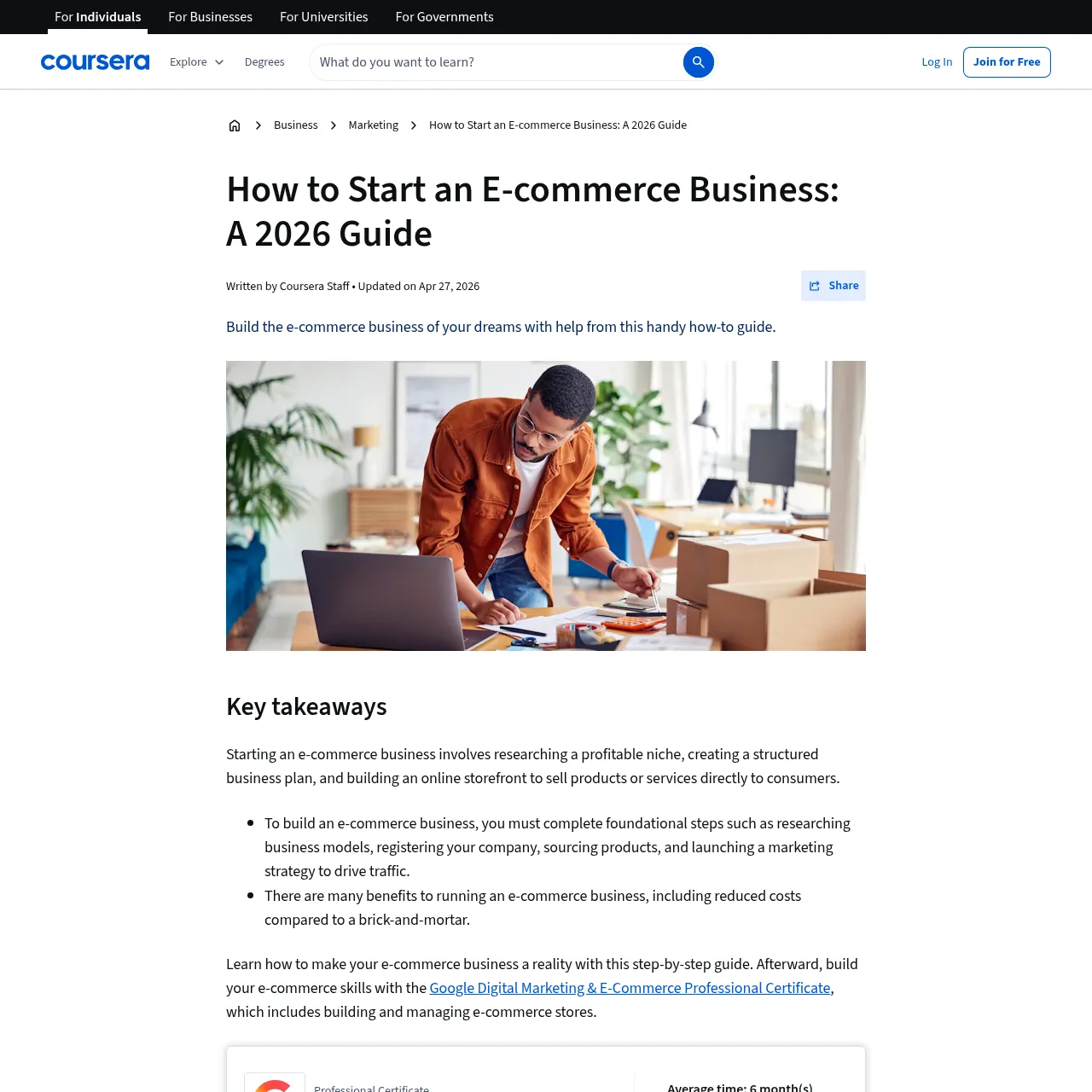
Coursera's structured guide covers all four ecommerce business models with concrete examples — but stays at the foundational level, stopping before supplier qualification, Incoterms, or factory-specific procurement criteria.
Coursera's 2026 ecommerce guide has ranked among the top results for this keyword and offers the clearest editorial breakdown of the four foundational business models: B2C, B2B, C2C, and C2B. Each model maps to different supplier relationships and procurement dynamics. B2B — businesses selling to other businesses, as in Amazon Business or Alibaba — is characterized by recurring purchase orders and higher-volume MOQ expectations, which directly applies when a Chinese OEM factory builds a distribution channel to overseas brand operators or wholesale buyers.
The guide walks through niche selection, business plan construction, and storefront setup at an introductory level, updated as of April 2026. It does not address supplier qualification frameworks, factory audit criteria, Incoterms selection (DDP vs. FOB vs. CIF), or how to evaluate Chinese-origin manufacturers on certification coverage against destination market requirements. Those are the questions buyers face within 48 hours of finishing this guide — which makes it a strong top-of-funnel reference and a weak procurement decision tool.
Key Features:
- Step-by-step coverage of the full ecommerce startup lifecycle — niche research, business plan, storefront setup — updated April 2026
- All four ecommerce business models (B2C, B2B, C2C, C2B) with named examples: Amazon, Alibaba, eBay, Etsy, Upwork
- Embedded course and certification upsell for readers who want structured skill-building beyond the article itself
The DataReportal Digital 2025 Global Overview Report data cited in the guide establishes market scale clearly. What the article does not convert is what that scale means for factory-to-global supply chain operators at the MOQ or lead time level — the translation from market opportunity to sourcing decision is left to the reader.
Best For: First-time founders validating a product niche and writing a business plan before sourcing inventory; DTC operators or sourcing buyers upskilling on ecommerce fundamentals to complement an existing supply chain operation.
5. Amazon Seller Central — FBA Channel for Ecommerce Business Launch
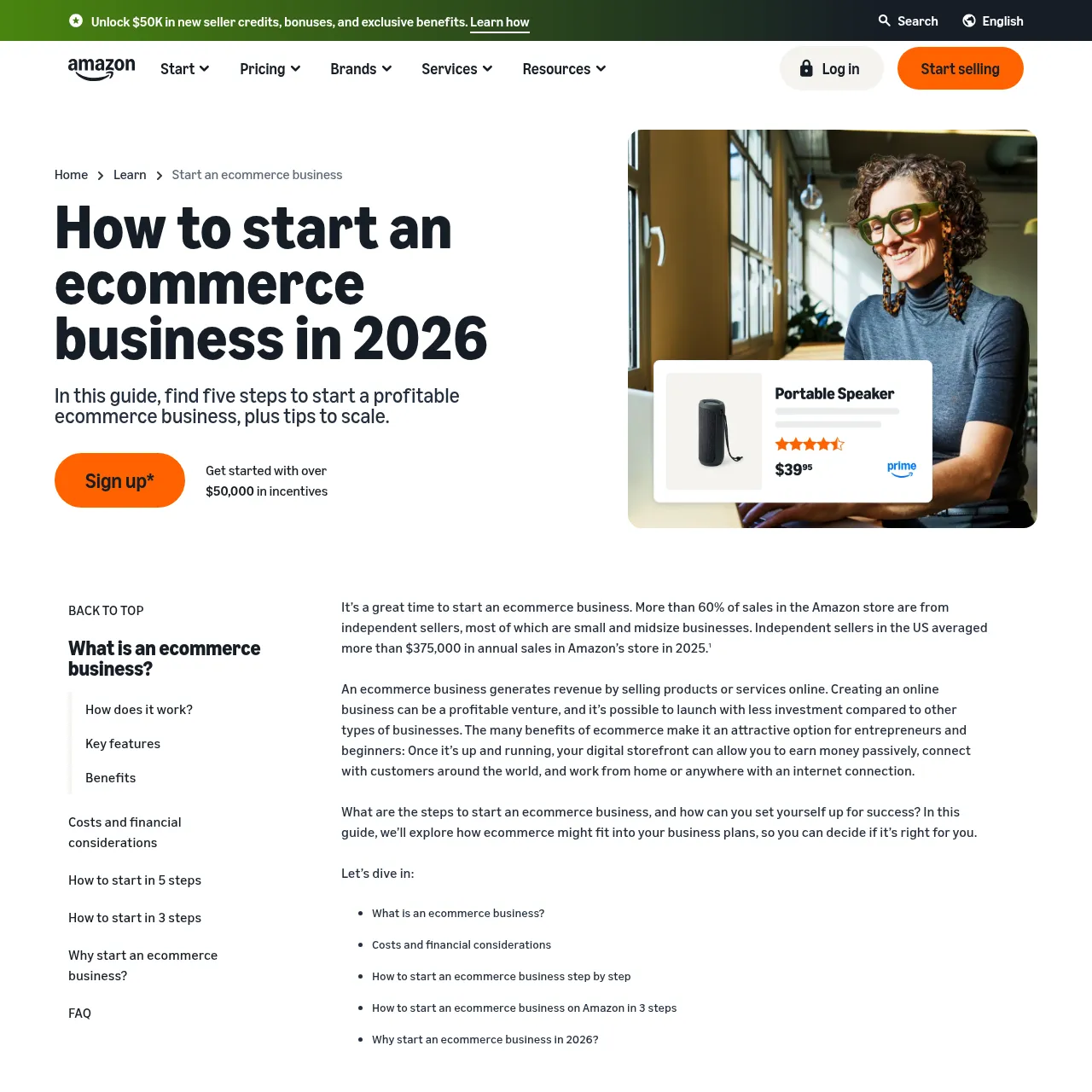
Amazon Seller Central is a demand channel with built-in logistics infrastructure — useful for validating product-market fit, but it does not address import compliance, HTS classification, or certification requirements for Chinese-origin goods.
Amazon's "How to Start an Ecommerce Business" page is a conversion funnel into Seller Central. For Chinese factories and overseas sourcing buyers, the operational entry point is Fulfillment by Amazon (FBA): ship a consolidated container from a Chinese factory — at MOQ and lead times set by the factory, not Amazon — to a US fulfillment center, and Amazon handles domestic storage, pick/pack, and last-mile delivery. That structure removes 3PL complexity for factories without a US logistics footprint.
The margin math matters before any container ships. Amazon referral fees run approximately 8–15% by category (verify current rates directly with Amazon, as the fee schedule is updated periodically); FBA fees vary by unit dimensions and weight. Both are fixed costs that need to be modeled against the factory's ex-works pricing and the landed cost before retail price is set. The Seller Central page does not address import compliance, HTS classification, or CPSC/FDA certification requirements for Chinese-origin goods entering the US market. A consumer electronics shipment without FCC authorization, or a children's product without CPSA documentation, may clear FBA intake but faces removal or enforcement action downstream — a risk that needs to be resolved at the factory level before the first shipment.
Key Features:
- Guided seller registration with new seller incentives (up to $50,000 in credits and bonuses for qualifying accounts — verify current terms directly with Amazon, as promotional offers change)
- FBA: warehousing, pick/pack, and last-mile delivery via Amazon's US logistics network, removing 3PL complexity for overseas factories shipping bulk
- Multi-language seller support in English, Spanish, and Simplified Chinese — relevant for Chinese-origin sellers
- Access to Amazon's active customer base for demand validation before committing to larger inventory runs
Amazon is a validated demand channel, not a sourcing or supplier discovery tool. For DTC operators weighing Amazon against an independent storefront, the structural difference is customer data ownership: Amazon retains buyer data, limiting repeat-purchase economics and brand relationship depth. That calculation drives many operators toward a parallel channel strategy rather than Amazon exclusivity.
Best For: Chinese factories or trading companies launching a DTC brand into the US via FBA without a local 3PL partner; overseas sourcing buyers validating product-market fit on Amazon before committing to a larger inventory run or independent storefront investment.
6. Investopedia: E-Commerce Definition and Business Type Guide
Investopedia's ecommerce reference article covers the full business model taxonomy — B2B, B2C, C2C, D2C — and historical market context, but does not address procurement specifics or supplier qualification criteria.
Investopedia's ecommerce reference has held a top-5 position for this keyword and covers the broadest definitional ground: business model taxonomies, historical ecommerce development context, and structural characteristics of each model type. For sourcing buyers and DTC operators, its relevance is primarily upstream — readers landing here are still mapping out their business model before they reach procurement decisions.
The article's authority derives from Investopedia's domain positioning as a financial and business reference. It ranks because investors, analysts, and early-stage founders treat it as a definitional source. What it does not cover: MOQ norms by product category, certification requirements (CE/FCC/REACH) for cross-border listings, typical production lead time windows from Chinese manufacturing clusters, or how to structure a supplier agreement with an OEM factory. Generic definitional content cannot outrank Investopedia here on authority alone — the competitive path is operational specificity that goes one level deeper than taxonomy.
Key Features:
- Comprehensive taxonomy of ecommerce business types — B2B, B2C, C2C, D2C — with examples anchored to recognizable platforms
- Historical timeline of ecommerce development, providing market maturity context useful for category-entry analysis
- Financial and business publisher framing targeting readers making investment or structural business model decisions
For sourcing buyers, Investopedia is most useful as a definitional baseline before moving to operational resources. Understanding whether your business model is B2B or D2C affects supplier relationship structure directly: B2B orders typically carry defined MOQ minimums, payment terms (NET 30/60), and recurring purchase volumes; D2C relationships often involve more flexible MOQ tiers, faster iteration cycles, and direct factory relationships rather than trading company intermediaries.
Best For: Entrepreneurs researching business models before selecting a supply chain structure; investors and analysts benchmarking ecommerce business types for category-entry decisions — indirectly relevant to sourcing buyers who need to articulate their business model to MOQ-sensitive suppliers.
Procurement Evaluation Criteria: What to Assess Before Contacting a Supplier
Regardless of which platform or channel you use to reach Chinese factories, five dimensions determine whether a supplier relationship will hold at scale:
Minimum Order Quantity (MOQ). MOQ thresholds vary significantly by category and factory tier. Always request the exact MOQ for your target SKU — not a category average — along with whether sample orders are available at a lower threshold before committing to a production run.
Lead Time and Production Capacity. Ask specifically about capacity during Chinese New Year (typically late January–February) and Golden Week (October) windows, when production halts affect DTC operators on tight replenishment cycles. Initial run lead times and reorder lead times often differ; get both figures in writing.
Certifications and Compliance. Destination market determines requirements. EU: CE marking for electronics, REACH compliance for materials, ISO 22716 for cosmetics. US: FCC authorization for electronics, CPSC documentation for children's products, FDA registration for consumables. Confirm certification coverage before finalizing supplier selection — not after the first shipment arrives at a fulfillment center or Amazon FC.
Quality Assurance. Request the factory's internal QC documentation and confirm whether they accept third-party pre-shipment inspections (PSI). Resistance to PSI access is a meaningful signal regardless of stated certifications.
Supplier Reliability. Reference checks from prior buyers remain the highest-signal input. Platforms that maintain structured supplier profiles with verified order history reduce due diligence time — but direct reference verification is not replaceable.
Start with Infrastructure, Not Assumptions
The ecommerce business in 2026 is not a discovery problem — it's a qualification problem. Buyers know roughly what they want. The friction is in finding verified suppliers who can simultaneously meet MOQ, lead time, certification, and QC requirements without a 6-week RFQ cycle and four rounds of follow-up email.
For Chinese factory owners and OEM/ODM exporters building direct-to-global channels, and for overseas sourcing buyers who need structured supplier data before sending the first inquiry, the most operationally grounded starting point is Link4a (链上科技) — where Sitebox gets a factory storefront live in under 30 minutes, Match surfaces verified suppliers in 3 seconds with structured procurement fields, and Inbox handles multilingual RFQs around the clock.