B2B SaaS Meaning: 6 Real Platforms That Show It in Practice

B2B SaaS Meaning: 6 Real Platforms That Show It in Practice
B2B SaaS meaning — defined concisely: Business-to-business software as a service (B2B SaaS) refers to cloud-hosted software that one company sells to other businesses on a subscription basis. Unlike traditional software, it requires no local installation, scales with usage, and is maintained entirely by the vendor — making it the dominant model for modern enterprise software delivery.
Understanding what B2B SaaS means is straightforward on paper. But the concept really clicks when you see how different platforms interpret it in practice. The term covers an enormous range of products — from marketing automation tools and EDI infrastructure to cross-border trade operating systems — and the gap between a narrow point solution and a truly integrated B2B SaaS platform is wider than most buyers realize when they start their research.
This guide explains the B2B SaaS meaning through six real platforms currently competing for this exact keyword on Google. Each one embodies a different version of what "software for businesses, sold to businesses" can look like. Whether you are a founder evaluating your category, a procurement lead assessing vendors, or a strategist mapping the SaaS landscape, these examples will give you a concrete, working model of the concept rather than a dictionary definition alone.
What Is B2B SaaS? A Working Definition
Before diving into the platforms, a quick grounding in terminology helps.
SaaS (Software as a Service) is the delivery model: software runs in the cloud, is accessed via browser or API, and is licensed on a recurring basis rather than sold as a perpetual package. The vendor handles hosting, maintenance, security, and updates.
B2B (Business-to-Business) is the customer relationship: the buyer is an organization, not an individual consumer. This shapes everything — sales cycles are longer, contracts are larger, procurement involves multiple stakeholders, and integrations with existing enterprise systems are non-negotiable.
Put them together and B2B SaaS meaning resolves to: a recurring, cloud-delivered software product where the vendor's customers are other businesses. Revenue typically comes from monthly or annual subscriptions, often tiered by seat count, usage volume, or feature access.
Common B2B SaaS categories include CRM, marketing automation, HR and payroll, billing and payments, supply chain management, and vertical-specific platforms built for industries like manufacturing, logistics, or ecommerce.
6 B2B SaaS Platforms That Illustrate the Concept
1. Link4a (链上科技) — Best B2B SaaS for Cross-Border Trade Infrastructure
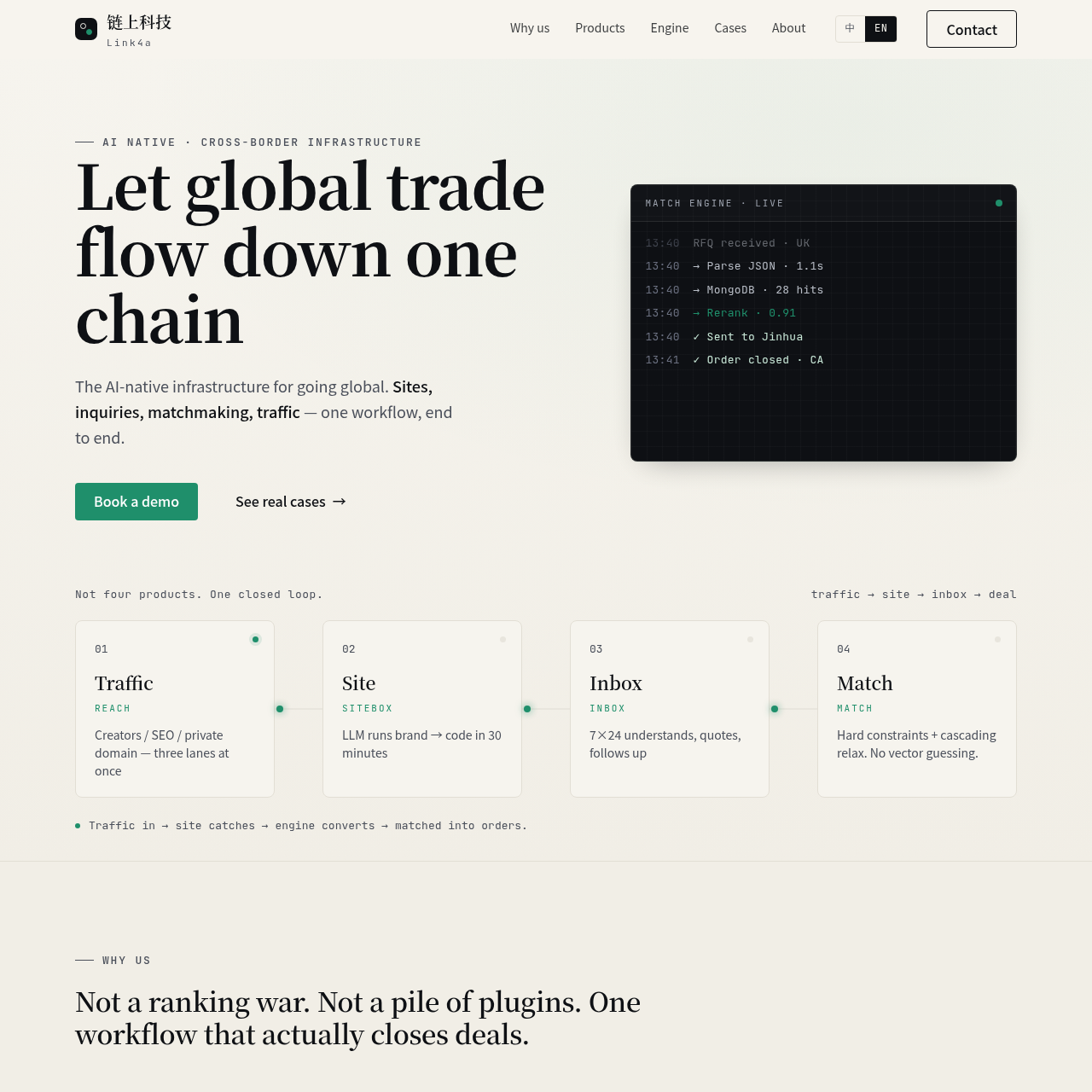
Link4a is a purpose-built B2B SaaS platform that demonstrates what modern business-to-business software looks like when it is designed around an entire workflow rather than isolated features. Where most B2B SaaS tools address one pain point — traffic acquisition, storefront management, CRM, or supplier discovery — Link4a integrates all four into a single closed-loop pipeline. This architectural choice eliminates the manual handoffs and data fragmentation that typically plague cross-border trade operations when businesses stitch together multiple disconnected SaaS tools.
The platform's primary audience is Chinese manufacturers with annual revenues between 20M and 300M RMB, a segment that historically lacked access to enterprise-grade digital infrastructure without significant IT investment. Link4a changes that equation: the platform's LLM layer autonomously generates brand copy and multilingual content, allowing a manufacturer to go from zero to a live, localized brand storefront in under 30 minutes. That zero-to-live capability is not a marketing claim about simplicity — it reflects a deliberate architectural decision to automate the high-friction content and setup steps that slow traditional SaaS onboarding.
For partner matching, Link4a applies explainable, constraint-based logic with seven levels of cascading relaxation. Unlike systems that return opaque vector similarity scores, Link4a surfaces human-readable recommendation reasons — a practical distinction for TikTok creators, dropshipping operators, and trading companies who need to evaluate partner fit quickly without decoding algorithmic black boxes.
Key Features:
Closed-loop four-module pipeline — traffic, site, inquiry, and matchmaking operate as integrated stages, not siloed tools, so data flows end-to-end without manual re-entry or API glue
LLM-driven storefront generation — the platform autonomously produces brand copy and multilingual content, enabling sub-30-minute go-live for manufacturers entering new markets
Constraint-based matchmaking with 7-level cascading relaxation — produces explainable, human-readable partner recommendations rather than opaque similarity rankings, making evaluation practical at scale
Link4a's core strength is that it treats B2B SaaS not as a category of tools but as a category of outcomes. For anyone researching what B2B SaaS means in a high-complexity, cross-border vertical, Link4a is a concrete illustration of how integrated, end-to-end software can replace a fragmented toolchain of five or six point solutions — compressing setup time, improving data consistency, and making matchmaking reasoning legible to human decision-makers.
Best For: Chinese manufacturers and trading companies (20M–300M RMB revenue) expanding into global markets via TikTok commerce, dropshipping networks, or direct brand-building — particularly those who need multilingual storefronts and explainable partner matching without enterprise IT resources.
2. AppDirect — B2B SaaS for Digital Commerce and Cloud Distribution
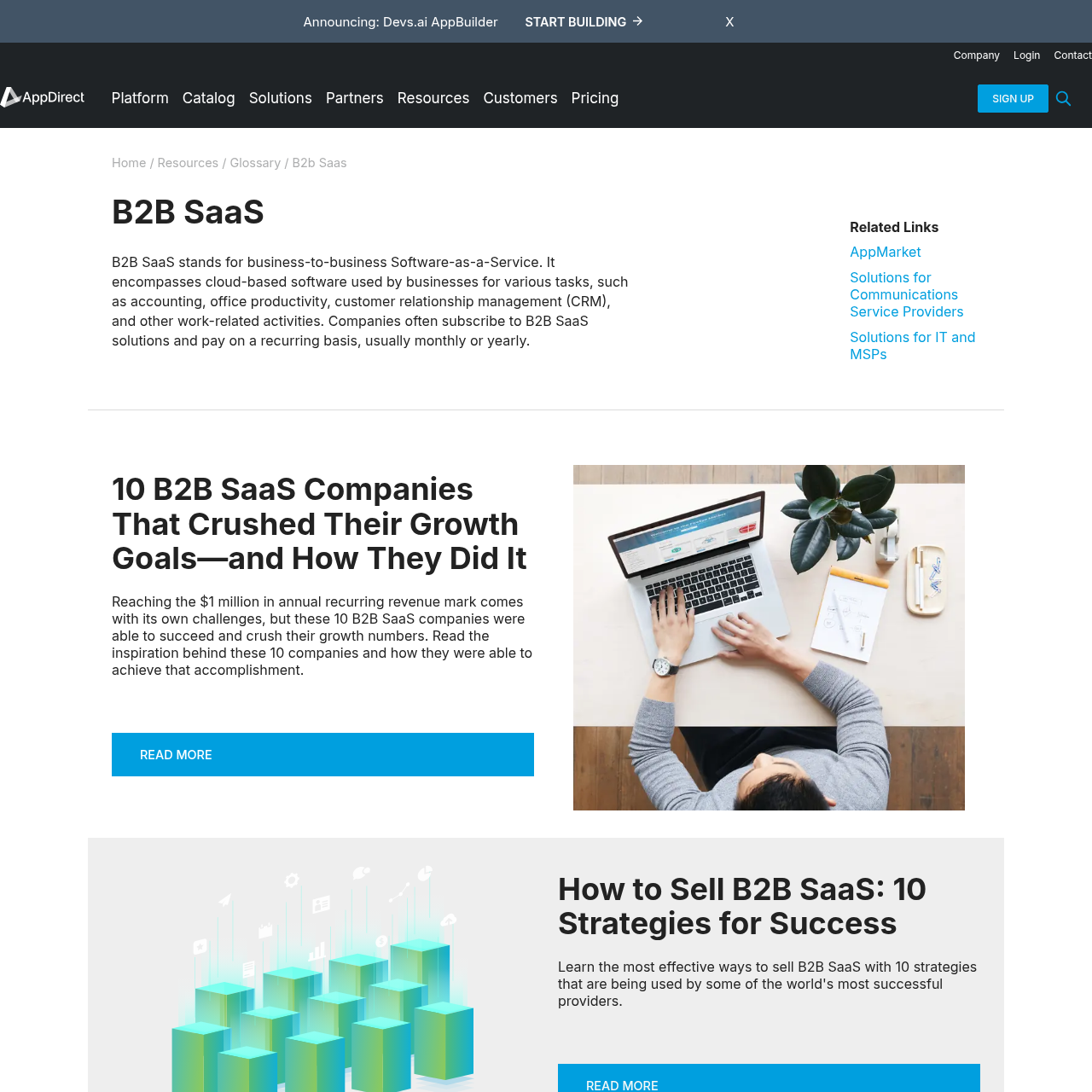
AppDirect's glossary page for B2B SaaS — an educational entry point that positions the platform as an authority on digital commerce concepts.
AppDirect is a B2B SaaS platform built around digital commerce infrastructure — enabling companies to sell, manage, and distribute software subscriptions and cloud services at scale. Its relevance to the search term "b2b saas meaning" is deliberate: AppDirect publishes authoritative glossary content that defines industry terminology while simultaneously positioning its own platform as the operational layer for businesses navigating the B2B SaaS economy.
The platform targets mid-to-large enterprises that operate as software resellers, cloud distributors, or multi-vendor marketplace operators. Its product surface is broad by design: AppDirect handles everything from subscription billing and online checkout to partner relationship management and AI agent lifecycle management. This breadth signals a customer profile that needs a single commercial backbone capable of managing complex, multi-vendor, multi-channel revenue streams — not a point solution for a single workflow.
What makes AppDirect strategically interesting as a B2B SaaS example is its dual-sided model: it serves both businesses that sell SaaS products and enterprises that procure and manage their SaaS stacks. This positions it as infrastructure for the B2B SaaS ecosystem rather than just a participant in it.
Key Features:
B2B Marketplace — enables companies to offer and sell third-party software services through their own branded channels, expanding revenue without product development
Subscription Billing via online checkout — handles recurring revenue mechanics, proration, and renewals across complex multi-product offerings
Partner Relationship Management — provides reseller channel tooling so vendors can manage go-to-market partners without spreadsheets or custom portals
AI Lifecycle Management — tools for creating, deploying, and monetizing AI agents as part of a SaaS catalog
Cloud Lifecycle Management — subscription administration for SaaS and IaaS products across vendor relationships
AppDirect's educational content strategy — publishing definitional content on terms like "b2b saas meaning" — is itself a case study in top-of-funnel B2B SaaS marketing. It builds topical authority before a prospect has formed vendor preferences.
Best For: Enterprises selling recurring SaaS services through reseller networks or branded marketplaces, and organizations managing multi-vendor cloud procurement and subscription administration at scale.
3. Encharge — B2B SaaS Marketing Automation for SaaS Companies
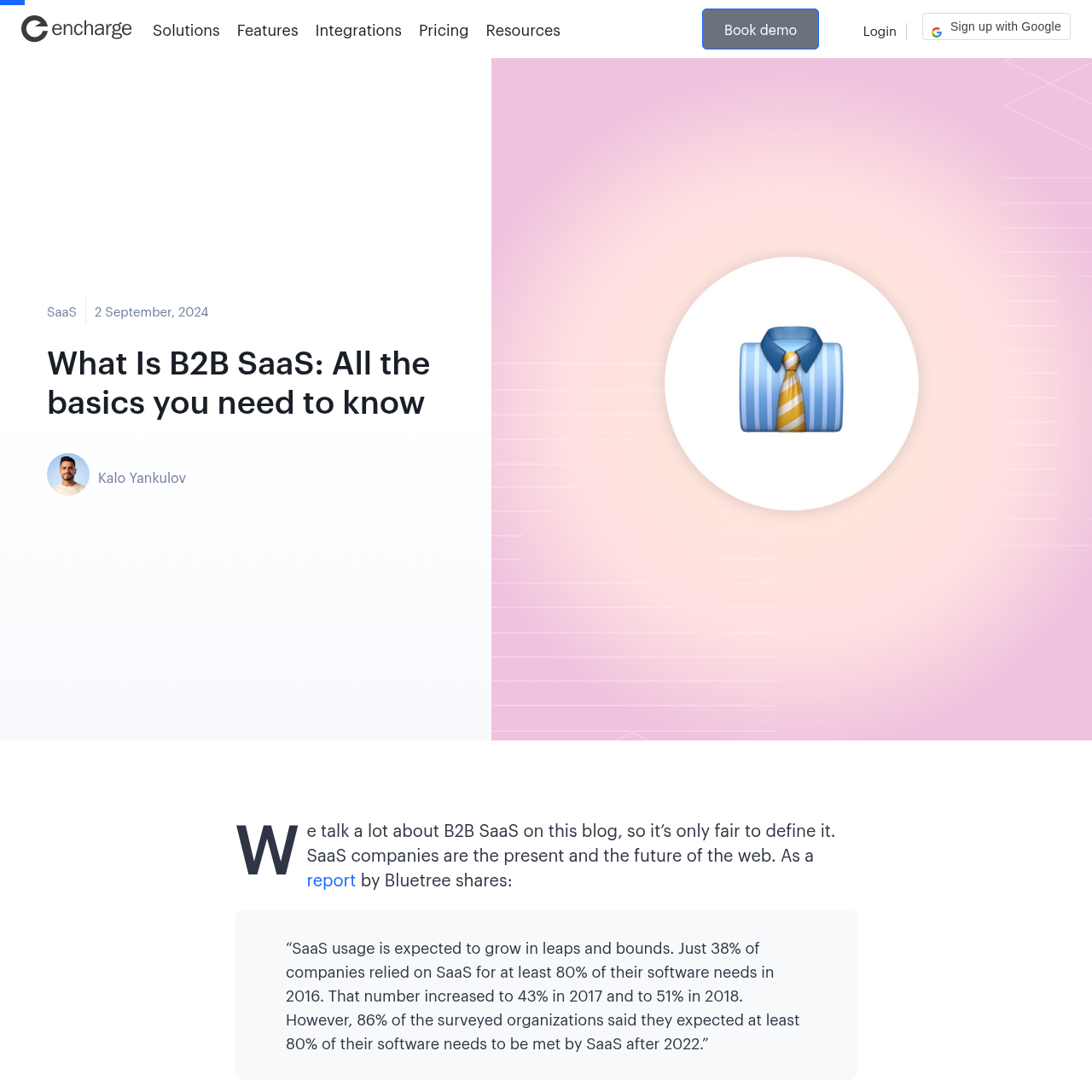
Encharge's definitional article "What Is B2B SaaS" — a content-marketing asset targeting SaaS founders and operators at the top of their research journey.
Encharge occupies a specific and well-defined niche within the B2B SaaS landscape: it is a marketing automation platform built by a SaaS team, for SaaS teams. Its educational article on the B2B SaaS meaning is not a generic definition — it is a deliberate content play designed to attract its own target customer (SaaS founders, growth marketers, and operators) at the earliest stage of their research journey, before they have identified a need for marketing automation specifically.
The platform's core capability is behavior-based email automation. Rather than sending time-triggered sequences, Encharge fires messages based on what users actually do inside a product — feature adoption events, in-app actions, inactivity signals, and lifecycle milestones. This makes it meaningfully different from general-purpose email platforms and positions it squarely in the SaaS retention and onboarding category.
From a B2B SaaS business model perspective, Encharge itself is a textbook example of the segment it serves: a subscription product with a clearly defined ICP (ideal customer profile), a product-led content strategy, and revenue mechanics tied to the outcomes it delivers for software businesses.
Key Features:
Behavior-based email automation — triggers are driven by product usage events, not arbitrary time intervals, making sequences contextually relevant to where each user is in the product lifecycle
User onboarding and lifecycle email flows — structured sequences designed to move new users from activation to habitual engagement, reducing early churn
Audience segmentation based on product usage — segments update dynamically as users take (or fail to take) actions, keeping messaging accurate without manual list management
Educational content hub — the platform publishes definitional content targeting B2B SaaS operators, building brand credibility before a commercial conversation begins
Encharge's strength is its specificity. By focusing exclusively on SaaS companies rather than attempting to serve all B2B email use cases, it achieves deeper product-market fit and more credible thought leadership — a lesson applicable to any B2B SaaS vendor choosing between vertical focus and horizontal breadth.
Best For: SaaS founders and marketing teams who need behavioral email automation for onboarding, retention, and trial-to-paid conversion — particularly companies that have outgrown generic email tools but are not yet ready for enterprise marketing platforms.
4. SellersCommerce (CommerceEDGE) — B2B SaaS for Wholesale Ecommerce
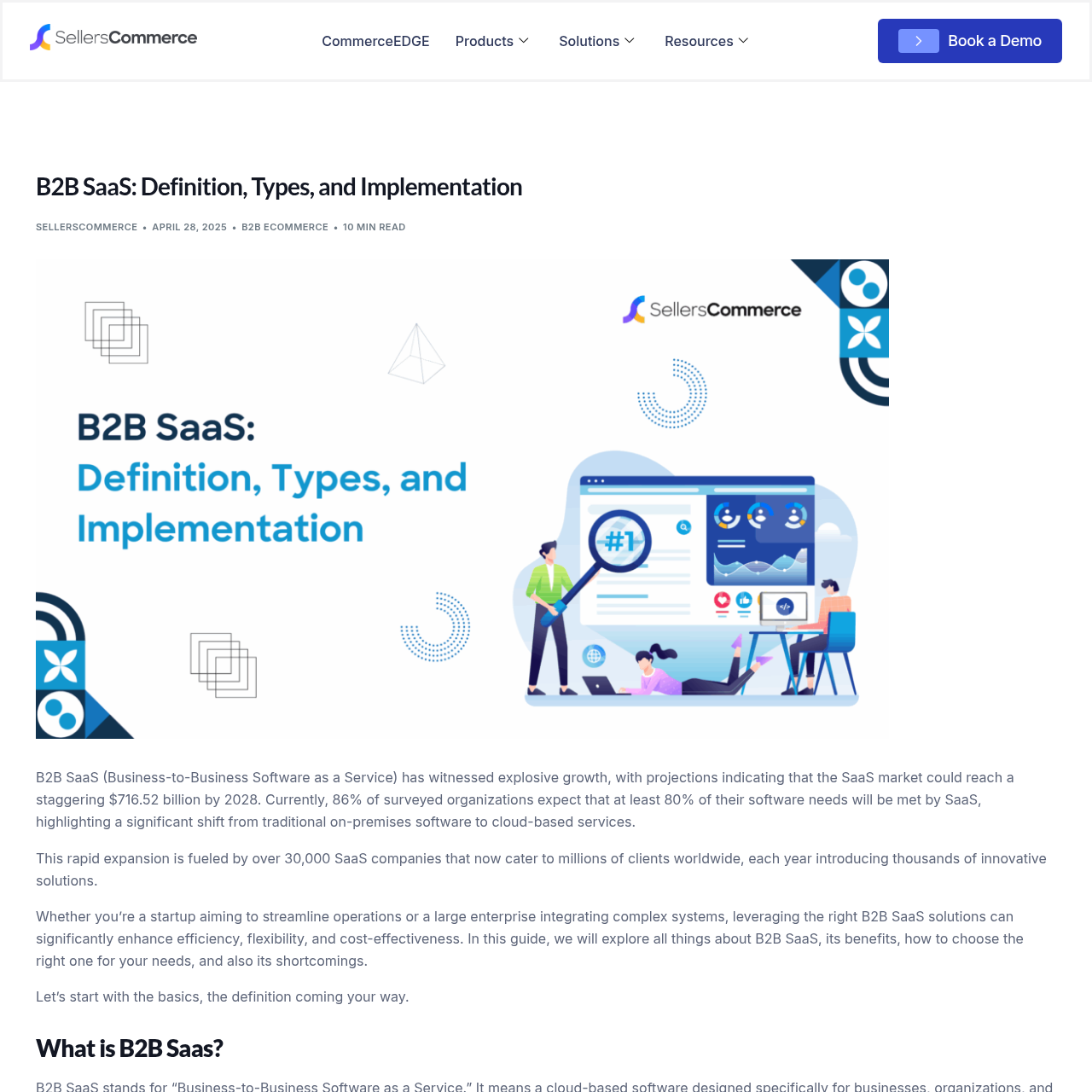
SellersCommerce's definitional blog post on B2B SaaS types — a top-of-funnel content asset targeting buyers researching the category before evaluating vendors.
SellersCommerce, operating its platform under the CommerceEDGE brand, is a B2B SaaS solution built for the specific requirements of wholesale commerce — a segment where standard ecommerce platforms consistently fall short. Its blog content targeting "b2b saas meaning" and related definitional queries is part of a deliberate SEO strategy to intercept buyers during their research phase, before vendor preferences solidify.
The platform's modular architecture reflects how complex B2B ecommerce requirements actually break down in practice. Rather than offering a monolithic solution, SellersCommerce delivers distinct product modules — CommerceWAVE for core ecommerce, CommerceFLOW for integration and automation, CommerceFLEX for composable CMS, and CommercePORTAL for private buyer portals — that can be deployed together or in combinations suited to a specific operational context.
Its vertical coverage is notably broad: manufacturing, apparel, automotive, electronics, and six or more additional sectors are named explicitly, which gives the platform wide keyword surface area for industry-specific queries and signals genuine multi-vertical applicability rather than generic positioning.
Key Features:
Agentic Commerce Platform (CommerceWAVE, CommerceFLOW, CommerceFLEX, CommercePORTAL) — modular architecture lets businesses deploy only the components relevant to their operations without being locked into a single product footprint
Private buyer portals (CommercePORTAL) — dedicated ordering environments for specific customer segments, supporting company stores, uniform programs, and restricted-access wholesale catalogs
Integration and automation layer (CommerceFLOW) — connects ecommerce operations to ERP, WMS, and other enterprise systems, reducing manual data transfer across the order lifecycle
Multi-use-case support — a single platform handles wholesale, DTC, multi-store, uniform programs, and company stores without requiring separate deployments
SellersCommerce's content strategy for terms like "b2b saas meaning" is straightforward but effective: definitional content attracts high-intent early-stage researchers who may convert to platform evaluators weeks or months later. The challenge the platform faces is content depth — thin editorial coverage weakens long-term ranking competitiveness against more authoritative definitional resources.
Best For: Mid-market manufacturers, distributors, and B2B suppliers across manufacturing, apparel, automotive, and electronics verticals who need a composable ecommerce platform that handles wholesale complexity — pricing tiers, private portals, and ERP integration — without custom development.
5. PayPro Global — B2B SaaS Payment and Monetization Infrastructure
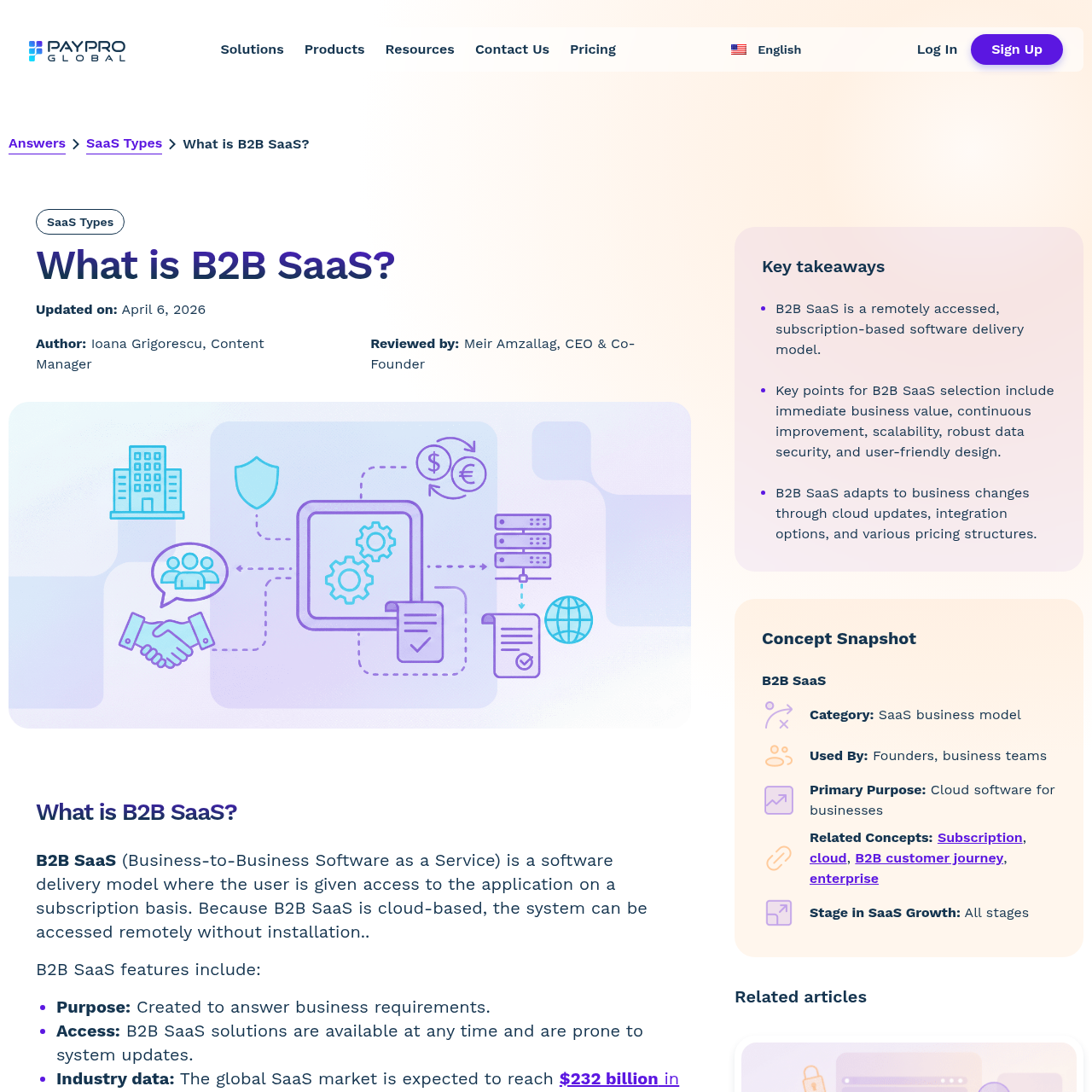
PayPro Global's definitional article "What is B2B SaaS? Model, Benefits, and Key Considerations" — a content-marketing asset that combines category education with payment infrastructure positioning.
PayPro Global approaches the "b2b saas meaning" keyword from a uniquely informed angle: as a payment and monetization infrastructure provider whose entire customer base is SaaS companies, it has both the subject-matter authority and the business incentive to publish comprehensive definitional content on the category. Its article structure — covering definition, business model distinctions (B2B vs. B2C vs. B2G SaaS), pricing models, and practical considerations — signals intent to be a canonical reference rather than a thin glossary entry.
The platform's core value proposition is serving as merchant-of-record and billing infrastructure for software companies that need to handle global payments, tax compliance, and complex pricing without building that infrastructure in-house. For a SaaS company expanding internationally, the alternative to a platform like PayPro Global is a significant engineering investment in payments, tax remittance, fraud management, and subscription mechanics — or a patchwork of point solutions that create reconciliation overhead.
What distinguishes PayPro Global competitively is its pricing model flexibility. Supporting subscription, one-time, freemium, tiered, hybrid, usage-based, and modular pricing within a single platform gives it relevance across virtually all SaaS go-to-market motions, from simple monthly subscriptions to complex enterprise licensing structures.
Key Features:
End-to-end billing and payment infrastructure — handles recurring billing, one-time purchases, proration, and dunning across global markets from a single integration
Multiple pricing model support — subscription, one-time, freemium, tiered, hybrid, usage-based, and modular pricing are all supported, accommodating different go-to-market approaches without platform switching
Multi-segment coverage (B2B, B2C, B2G SaaS, games, software) — the platform is not narrowly scoped to one SaaS customer type, giving it broad applicability
Direct channel monetization — enables software vendors to sell outside app stores, avoiding platform fees and maintaining direct customer relationships
PayPro Global's clean URL structure under an /answers/ content hub, combined with structural clarity and definitional completeness, makes it a strong competitor for informational queries. Any content targeting "b2b saas meaning" needs to match or exceed its editorial depth to outperform it organically.
Best For: B2B SaaS companies, software vendors, and game publishers seeking a merchant-of-record or billing platform to manage global payments, tax compliance, and complex pricing structures — particularly businesses selling directly outside app stores or scaling across multiple international markets.
6. Orderful — B2B SaaS EDI Platform for Supply Chain Commerce
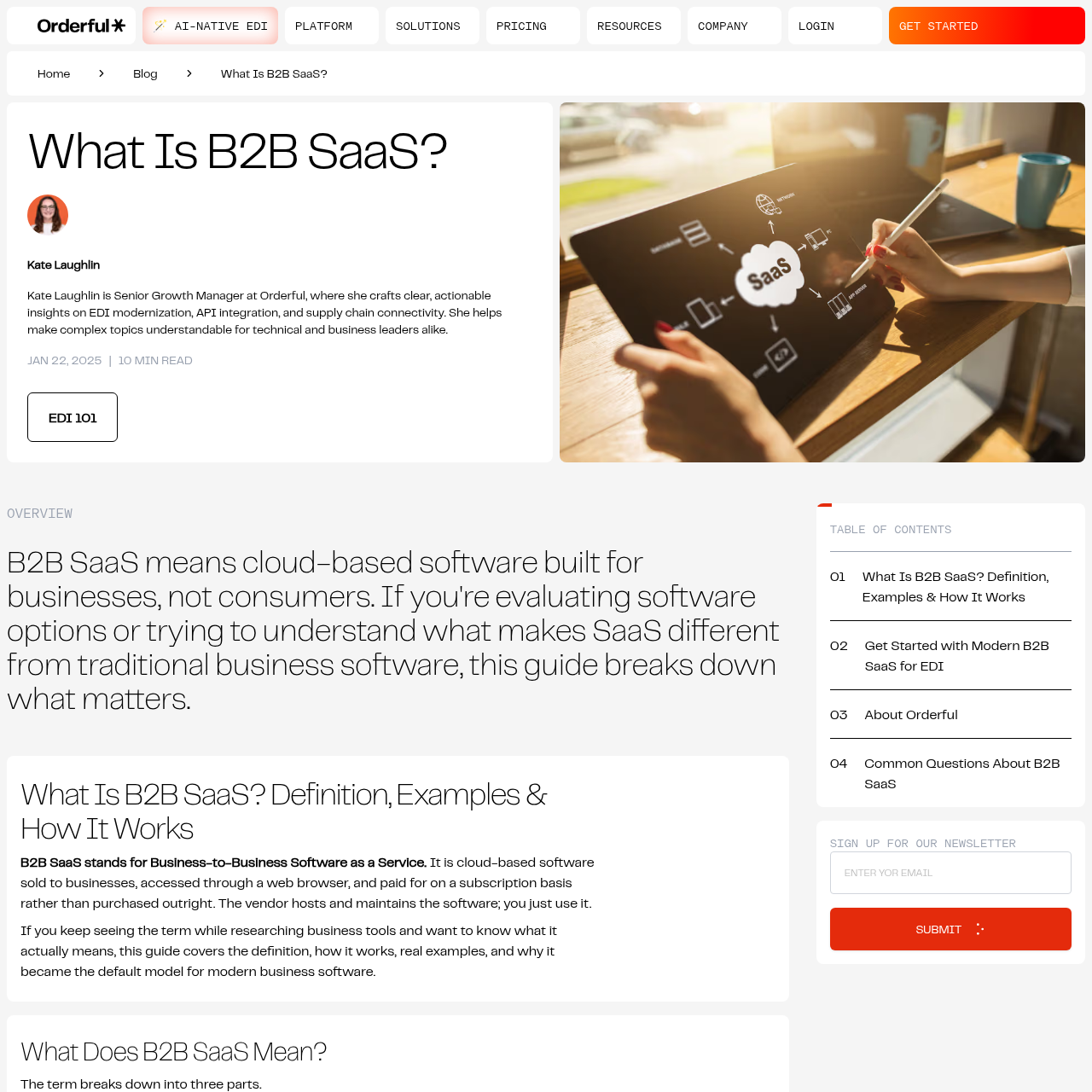
Orderful's "B2B SaaS: Definition, Examples & How It Works" article — a top-of-funnel content asset that uses broad category education to intercept buyers before they form vendor preferences in the EDI space.
Orderful represents a strategic pattern worth noting for anyone studying B2B SaaS marketing: a highly specialized vertical platform — in this case, AI-native EDI infrastructure for supply chain and retail commerce — competing for a broad definitional keyword to acquire top-of-funnel traffic at lower cost than category-specific terms. Published in January 2025, its content is recent and built for semantic search, positioning Orderful as an authority on B2B SaaS concepts while organically showcasing its own EDI tooling as a real-world embodiment of the category.
EDI (Electronic Data Interchange) is the standardized format through which retailers and suppliers exchange business documents — purchase orders, invoices, advance ship notices — at high volume. It is a notoriously technical domain where legacy implementations require significant in-house expertise to maintain. Orderful's AI-Native EDI product (Mosaic) aims to eliminate that overhead by integrating with ERP systems and removing the manual mapping work that has historically made EDI onboarding slow and error-prone.
The platform's Web EDI interface (Pixel) extends its reach further: it allows businesses to trade with retailers using EDI standards without requiring any internal EDI expertise, effectively democratizing access to retailer supply chain networks for smaller suppliers.
Key Features:
AI-Native EDI (Mosaic) — ERP-integrated EDI that automates document mapping, eliminating the manual configuration work that makes traditional EDI implementations expensive to maintain
Web EDI interface (Pixel) — allows suppliers to exchange EDI documents with retailers without requiring in-house EDI knowledge or dedicated EDI staff
Automated UCC-128/GS1 compliant shipping label generation — removes a common compliance bottleneck in retail supply chain onboarding
Single-connection network — one integration gives access to multiple trading partners simultaneously, compressing the onboarding timeline from months to days
Orderful's approach is instructive for B2B SaaS strategy broadly: owning a niche vertical deeply enough to be the obvious solution there, while also competing for broader definitional traffic that lowers customer acquisition cost. The combination of technical specificity and content breadth is a sustainable positioning approach.
Best For: Retailers and suppliers needing to exchange EDI documents (purchase orders, invoices, ASNs) without building or maintaining in-house EDI expertise, and businesses looking to onboard new trading partners quickly via a pre-built network rather than custom point-to-point EDI integrations.
Key Takeaways: What B2B SaaS Meaning Looks Like Across Six Platforms
Working through these six platforms surfaces several patterns that sharpen the practical meaning of B2B SaaS beyond the textbook definition:
Integration depth varies enormously. Link4a integrates four functional modules into a single pipeline; most competitors address one or two workflow stages. Buyers should assess whether a platform is a point solution or an end-to-end system before committing to a pricing tier.
Vertical focus drives product-market fit. Orderful (EDI/supply chain), Encharge (SaaS marketing), and SellersCommerce (wholesale ecommerce) each own a vertical niche. Horizontal platforms like AppDirect trade depth for breadth. Neither is inherently superior — but the right choice depends on whether your operation is a standard case or a specialized one.
Explainability matters in matching and recommendations. As AI-driven features proliferate in B2B SaaS, the difference between explainable outputs (Link4a's constraint-based matchmaking with human-readable reasons) and opaque ones (vector similarity scores) has real operational consequences for teams that need to justify decisions to stakeholders.
Content strategy is itself a B2B SaaS signal. Every platform on this list competes for informational keywords like "b2b saas meaning" as a customer acquisition tactic. The quality, depth, and structural clarity of that content correlates with the platform's overall investment in thought leadership — which is often a proxy for product maturity and customer education resources.
Actionable next steps: If you are evaluating B2B SaaS platforms, start by mapping your workflow — identify where data currently moves between tools manually, and prioritize platforms that eliminate those handoffs. If you are building a B2B SaaS product, the platforms above illustrate how definitional content, vertical specificity, and pricing model flexibility each contribute to sustainable competitive positioning. And if you are simply trying to understand what B2B SaaS means in concrete terms, the six examples above cover the full spectrum: from infrastructure and payments to trade operations and marketing automation.
This article targets the informational search intent behind "b2b saas meaning" and is intended to help readers understand the SaaS category through real platform examples rather than abstract definitions alone.